|
The Architectural Impact
of the proposed modifications to St George’s
Church
"House on the Rock views itself as the steward of its
premises, held in trust for the benefit not solely of its attendees
but for the entire community....House on the Rock believes that
humankind is made in the image of God and that our creativity
is an expression of this."- quotations
from Section 106 Policy agreement,.
Planning Permission for the architectural alterations at St
George’s, and change of use from a Theatre to a Church
has been granted. However, the irregularities in the planning
meetings that led up to permission being granted have been well
documented here and in the press. There are, indeed, sufficient
grounds to call for a full Planning inquiry and independent
judicial review in terms of:
1. the architectural damage to the building
2. the potential impact of the change of use
3. the disregard for local opinion which has typified the entire
process
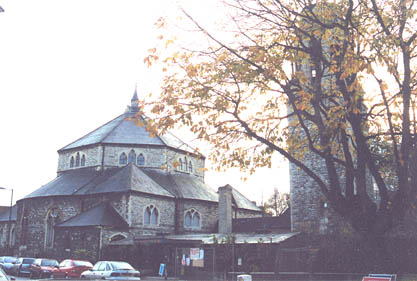
St George’s prime significance architecturally is as a
building in the round. The dome and floor plan is unique both
as a church and as a theatre. HOTR’s proposed gallery seating
structure will permanently alter the unique acoustic and religious
significance of the building, albeit under the direction of
the good intentions quoted above
St George’s is painstakingly based on a Templar design,
not, as HOTR asserts, a ‘Greek’ church. Neither is
it built merely ‘in a gothic style with quasi-Byzantine
influences’ as the House on the Rock planning application
details. It is also contains an octagonal arcade of pillars,
and not hexagonal as the HOTR application describes.
These are important differences. The whole outer circular structure
manifests acoustic, mathematically demonstrable, resonant qualities
which are comparable to the great domed churches of London such
as St Paul’s Cathedral or St Sophia in Istanbul. As in
many domed churches, we experience here an interaction between
Eastern (Islamic) and Western sacred architecture. The building
is inviting a particular gesture of inclusivity from its current
owners.
HOTR's proposed alterations would essentially knock several
holes in the outer shell of the original wall of the church
for access at both the ground floor and first floor levels.
The proposed external one-story structure is connected to the
proposed interior gallery by several doors. They would also
have to have fire exits at this level - nowhere detailed or
even indicated on the Planning Application drawings. The fire
exits would further compromise the existing round walls of the
church. With a proposed congregation of up to 900, these fire
escapes will also need to be large. The outer wall of the building
is critical to the integrity of both the outer form and inner
acoustic. The proposed GALLERY as a second layer of seating
will damage both irrevocably.
If Islington Council supports the use of St Georges reverting
to a church, they must also acknowledge its precise nature as
a church building, both as to its structure and its intended
occupants and current owners. It is clear to the undersigned
that not sufficient attention has been given to the architectural
impact this planning proposal will have on the building itself.
Although the change of use has been approved from a theatre
back into a church, the proposed alterations will disfigure
one of the most numinous church buildings in London. From the
perspective of theatre the building has a different significance
architecturally. Theatre is not merely a function of a building,
it also determines its form. HOTR are to be praised in maintaining
the entire stage area, and indeed supplementing the performative
potential of the building by siting a bandstand behind the stage.
The maintenance of the current stage arrangement in terms of
siting and orientation reinforces the HOTR claim to responsible
ownership, but their intention to sabotage the acoustic of the
building by inserting the large (250 seat) and permanent gallery
level seating is a disaster for the form and authenticity of
the building. The Victorian Society and many other local groups
and individuals have expressed concern about the plans for the
gallery.
Although currently dilapidated, the original architecture of
the building has been satisfactorily maintained throughout its
use as a theatre and community centre for over 35 years. With
its stage and possible seating variations, it is also a perfect
theatre-in-the-round, which in terms of flexibility is unique
in London. The combined architectural merit of the building
as both church and theatre makes St George’s a valuable
and irrevocable jewel in the crown not just of London’s
sacramental Architecture, but also of working London Theatres.
It is valuable because in architectural terms it is both a Church
and a Theatre.
In terms of maintenance and establishing its Heritage significance,
money must be allocated to protect this unique structure, and
if House on the Rock were able to maintain the building in terms
of what the architecture of the building demands, they could
proceed to refurbish it with the community’s blessing.
Thus in passing the initial planning consent on February 14th
2005, Islington Council might be said to have supported the
refurbishment of what was at the time of purchase a derelict
building. Its sale, however, was both protracted and, it has
to be said, highly unusual from the perspective of normal disposal
of charitable assets, although in this, the finger of blame
must point not at HOTR but to the individual who made over a
million pounds profit from a building owned by and funded as
a registered Charity.
Despite concerns about the future of St George’s Theatre
expressed by members of the local community over a period of
many years, Islington Council has not seen fit to allocate funds
for a public debate as to the best use of the building, nor
its significance as a community centre. Nor were the local community
adequately consulted by the Council or by HOTR, as their Planning
documents assert. Islington Council may have obeyed the “letter
of the law”, in that change of use notification and the
tricky problem of removing Covenants established on a building
need only be given to the immediate locality, perhaps a hundred
houses at most. However, recent petitions in the area, in addition
to the ones held years ago (by Save London’s Theatres)
testify to extensive anxiety about the loss of an active Theatre/
Arts facility in the area. This is, a community and architectural
as well as a planning issue. Like many churches the building
holds a key position both geographically and demographically.
It has served a function for over 30 years as a theatre and
major community arts centre over a huge swathe of wards and
parishes from Islington to Archway, Holloway, Highgate, Kentish
Town, Tufnell Park, and Hornsey, but due to the neglect of recent
years, has yet to reach its true potential, as a community arts
centre made viable and sustainable by mixed use.
Both as an Ecumenical – rather than Evangelist church
- and as a Community Centre, St George’s has tremendous
potential if the two functions of the building – religion
and art – can be held in some sensible relationship. This
primary relationship to architecture, to the building itself,
(ie what it has recently and historically been used for –
a theatre and a church) must surely precede and inform discussion
of its present use if a good result is to emerge from the current
106 discussions.
Furthermore, no mention is made in the section 106 agreement
about the use of the building by other – community based
– religious groups. This should also be included, under
the Charitable laws governing this country. HOTR is a religious
charity, and as such is bound by its dedication to the Christian
faith. No-one is seriously expecting the HOTR to include Jewish,
Muslim, Hindu or Pagan ceremonies and events at the Church,
although that would be a spectacular gesture, but the building
should also remain open to a community-based Ecumenical inquiry
into the Christian faith that underpins the life of the Christian
Church as a whole.
The wide range of architectural references in the building
– the Templars did, after all, take their name from The
Temple of the Rock in Jerusalem, which St George’s octagonal
structure famously references – invites the participation
of a broader congregation than HOTR are offering. We therefore
also object to the use of the church by a restricted congregation.
Though no money has been spent on the building since House
on the Rock purchased it, either by English Heritage, HOTR or
the Council – in spite of invitations to all three to do
so – St Georges Theatre is still basically in perfect condition,
in terms of its original structure. Minor roof repairs are needed,
as in most C of E churches throughout the UK. HOTR claim their
proposal will revivify the building - which they wrongly describe
as having been effectively vacant since the late 1980’s.
In point of fact it was being used as a Shakespearean theatre
as recently as 2000, when a startling and original Romeo and
Juliet was produced there.
To conclude, most opponents on architectural grounds to the
current development have little objection to the proposals as
far as the external and cosmetic developments are concerned,
as the existing temporary structures around the building clearly
need replacing. However, the gallery development inside St
George’s Church is unacceptable, both in terms of the holes
being knocked in the wall and the permanence of the gallery
seating. The House on the Rock must have scant understanding
of the architectural significance of this building if they wish
to impose permanent gallery seating in it. Its acoustic is currently
perfect, with the dome a resonating chamber as effective as
St Paul’s cathedral’s famous ‘whisper’ effect.
Under the existing plans, this Grade 2 listed building would
be architecturally nullified and its immense potential as an
ecumenical and community building would be lost.
Collated by Dan Skinner
as at 24th October 2005
|