|
Neighbourhood Issues raised
in relation to Islington Council’s stated Planning Policies:
The Draft for Islington’s 106 Area Strategy
(which appears on their website Islington Council –Planning)
gives “eight objectives or themes” for “the future
of Islington over the next ten years”. (Section 4:4)
http://www.islington.gov.uk/Environment/Planning/default.asp
http://www.islington.gov.uk/Environment/Planning/PlanningPolicy/
http://www.islington.gov.uk/Environment/Planning/MajorSchemes/GivingBack/1414.asp
+ A Safer, more inclusive Islington1)
+ Learning Islington (2)
+ Healthier Islington (3)
+ Affordable quality homes (4)
+ A place to work and do business (5)
+ A cleaner, greener Islington;(6)
+ A place made up of inclusive communities (7)
+ Services which meet the needs of a diverse local community.
8() (my numerics)
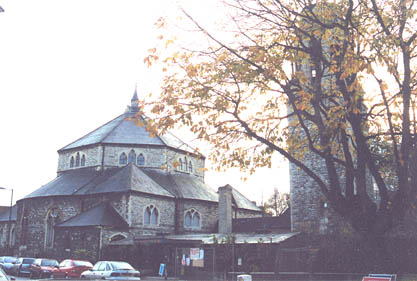
St. Georges Theatre and Islington’s Area Strategy
House on the rock (HOTR) are unlikely to contribute to
a more inclusive Islington or a Learning Islington
for a number of reasons. When St. Georges Theatre existed as
a Protestant Church, planning permission was granted (presumably
at the expense of residential properties) for another Church
building to be built almost opposite the original location.
HOTR describes itself as being “a Protestant Church”
(original information to residents). How do two Protestant Churches
opposite each other make Islington “more inclusive”
?
For information on the HOTR, go to their UK website 20/10/05
- www.hotr.org.uk/about.asp.
Islington has an extremely high student population. The Nigerian
HOTR website last year stated that children should not be given
schoolbooks or have access to libraries as this diminishes parental
choice and responsibility. The UK and the Nigerian branches
of HOTR are held to be part of the same Church, so I e-mailed,
telephoned and wrote letters to HOTR in Wembley, asking whether
this educational policy applied to HOTR UK. No-one would give
me an answer. When I asked the Pastor responsible for HOTR UK
(after the Archway Planning Meeting) I was told that his solicitor
had told him not to answer questions such as these. Furthermore,
the Pastor refused to give me an answer.
The conversion of the Theatre to a church would not lead to
a cleaner, greener, Islington. At the Archway
planning meeting it was stated (by a councillor) that parking
provision could be made in the Odeon Cinema and Acland Burghley
School car parks. The Odeon car park (14 spaces) is presently
used by The United Kingdom of Christ Church on Sunday mornings.
The school car park (some 20 minutes walk away) is presently
used by an Ethiopian church on Sundays and has a capacity of
about twenty cars. Even allowing for the use of several mini-buses
and some car-sharing, it could reasonably be argued that each
service could bring an additional two hundred vehicles to Tufnell
Park. At present there is residents and/or metered parking on
the whole length of Tufnell Park Road for less than a hundred
vehicles (1/10/05). Many of the properties to the rear of the
Theatre have been converted to flats and so there is little
space available on Sunday mornings. There is little evidence
that there are any local supporters of HOTR who would walk or
cycle (the nearest home fellowship is in Enfield – HOTR
UK website 20/10/05). It would appear almost all of participants
would come from outside Islington.
Section 6:2 identifies that two of “the main environmental
problems in the borough” are “too much traffic, particularly
on the borough’s main routes…”
Tufnell Park Road is, since the introduction of the Congestion
Charge and the construction of Kings Cross Station, one of the
main roads from the A1 to Kentish Town, Kings Cross, Euston,
Highgate, Swiss Cottage and Hampstead Heath. With around 1000
people proposed in Clergy, choir and congregation there is a
clear case that needs to be addressed of contravention of Islington’s
area strategy.
Islington also has various 106 Area Strategies, including Kings
Cross. This includes the provision of developing the tourist
and leisure sectors, both domestic and international. St. Georges
Theatre would appear to be the only “working” theatre
that exactly replicates the conditions for which Elizabethan
authors wrote. Thus, one could stage Dr Faustus as Christopher
Marlow intended (if it was commissioned by The Rose Theatre).
Even in its semi-derelict state, and without any advertising,
it still attracted numerous visitors from America and is still
listed as a theatre in at least one tourist guide - LondonTown.com.
By removing part of one wall and constructing, essentially,
a rectangular hall, it will cease to be of any historical significance.
The conduct of the Planning Committee meeting in Archway was
a disgrace. Their decision to grant planning permission was
clearly a foregone conclusion, despite the meeting being attended
by over 100 local residents, who individually and collectively
had many important objections to make. When I raised my concerns
about school and library books, the response of one of our local
councillors (who had already stated in the local press that
he was opposed to the community's concerns over the future of
the building), was that they were “irrelevant” and
that I was ”a squatter”, making it appear that an
Islington Councillor would agree to an organisation locating
itself in Islington, whose beliefs may, apparently, contravene
British law ! The same councillor went on to interrupt other
speakers, including a Professor of Town Planning and a lecturer
in architecture who both strongly opposed the plans to covert
the building into a church, also referring to them as “squatters”.
On the other hand, the comment made by HOTR’s architect
that planning permission should be given to buildings reverting
to their original uses were not interrupted and when he had
finished his speech, the chair refused to allow a comment from
the floor, that the building had been a theatre for nearly 40
years, on the basis that the person already spoken once. Numerous
local residents stated that they hadn’t been consulted,
including the owner of a house almost next door to the theatre.
In another case which mirrors this one, the Ombudsman has upheld
a complaint regarding a council granting planning permission
on ground next to a 12th Century church subject to the church
being used as a theatre, because the conditions prevented almost
every production actually taking place.
We have examined the hiring policies of HOTR – see detailed
commentary – and we find that there are so any loopholes
that it is difficult to imagine any productions taking place
there at all, even if anyone doing genuine community theatre
could afford the hire fees.
Compiled by David Spector
24/10/2005
|